

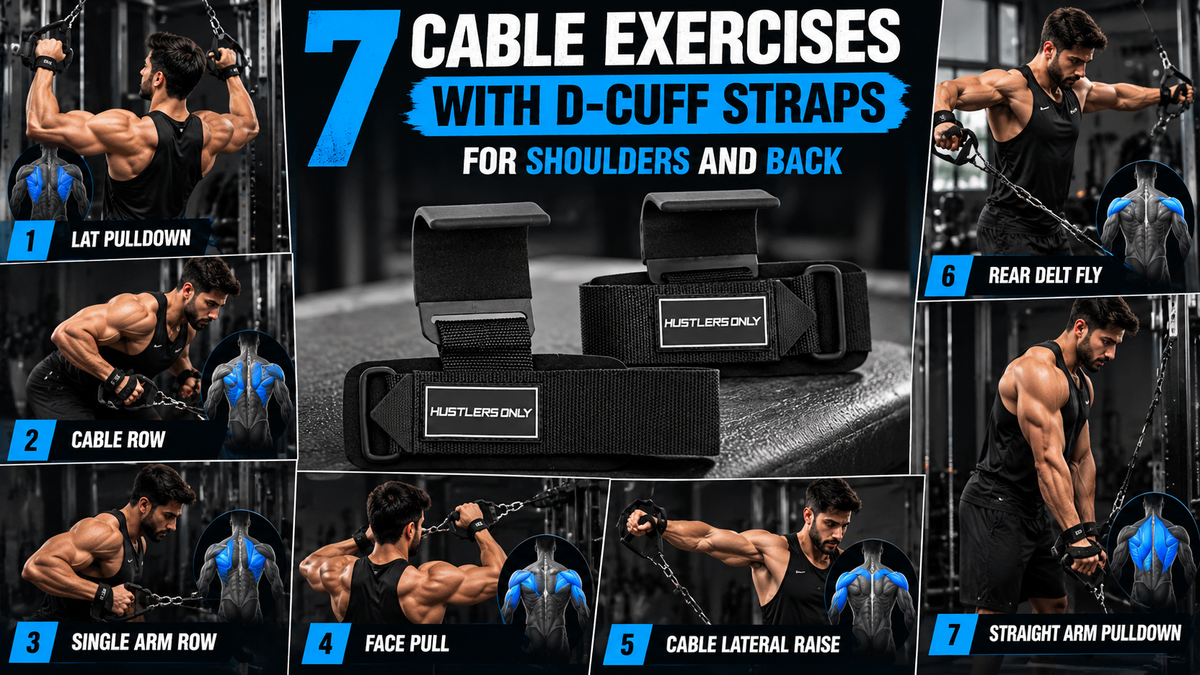
The D-ring on a D-cuff strap lets you clip a cable machine straight to your wrist. With no handle to hold, your grip stops being the limit and you can focus on the muscle you're training. Here are seven cable exercises to do with D-cuff straps, how to do each one, and a simple workout to get started.
Why use cuffs on a cable?
- Your grip won't end the set. The cable pulls from your wrist, so tired hands and forearms don't cut your reps short.
- Your hand can stay relaxed. Some lifters find this makes it easier to feel the target muscle working.
- Cables keep tension on the muscle through more of the movement than many dumbbell exercises.
Coach Jeff Nippard recommends cuffs over a D-handle for cable lateral raises. In his own max-rep test, he got two extra reps with cuffs, and he says they improve his mind-muscle connection.
Set-up basics
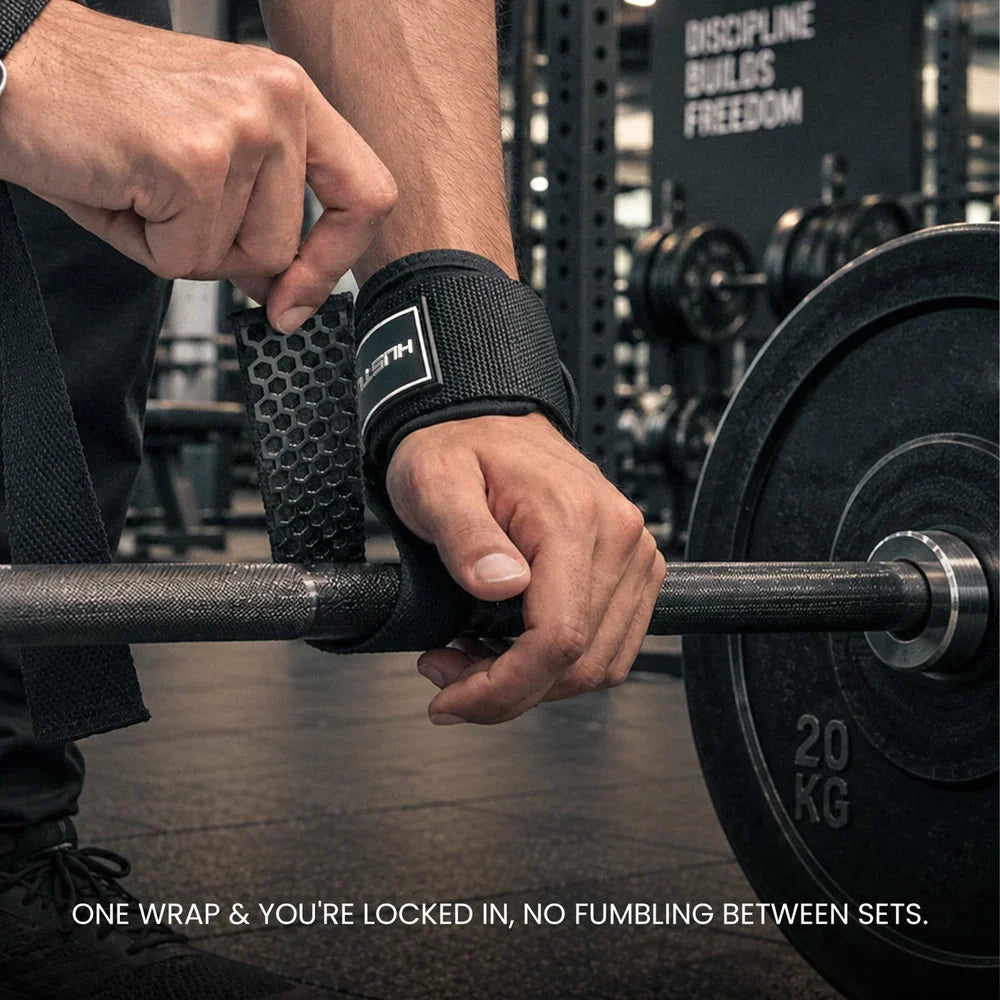
- Fasten the cuff snugly around your wrist.
- Remove the handle and clip the cable's carabiner onto the D-ring.
- Check the carabiner gate is fully closed.
- Start lighter than you'd use with a handle, and control every rep. These are isolation exercises, so clean reps matter more than heavy weight.
New to D-cuffs? Read our guide on how to use D-cuff lifting straps first.
Shoulder exercises
1. Cuffed cable lateral raise
Works: side delts
- Set the pulley low and stand side-on to the machine, with the cuff on the wrist furthest from it.
- With a slight bend in your elbow, raise your arm out to the side until your upper arm is about level with your shoulder.
- Pause, then lower slowly. Don't shrug or lean away to swing the weight up.
Try: 2–4 sets of 12–20 reps per arm.
2. Cross-body cable lateral raise
Works: side delts, with more stretch
Set up as above, but start with your working arm across the front of your body so the cable stretches the shoulder at the bottom. Raising the pulley a little puts more tension on the muscle early in the rep, one of the three tips from Jeff Nippard mentioned above. Use a lighter weight than for the standard version.
Try: 2–3 sets of 12–15 reps per arm.
3. Cable rear delt fly
Works: rear delts and upper back
- Set the pulley at shoulder height and stand side-on to it, with the cuff on the wrist furthest from the machine.
- Start with that arm reaching across your chest towards the machine.
- Keeping your arm almost straight, pull it out and back until it's in line with your shoulder.
- Return slowly. Keep your torso still and your shoulders down.
Try: 2–4 sets of 12–20 reps per arm.
4. Single-arm cable Y-raise
Works: side and rear delts, lower traps
- Set the pulley low and stand side-on, with the cuff on the wrist furthest from the machine.
- Raise your arm up and out at an angle, so your arm and body would make a "Y" if you did both sides.
- Stop around head height, then lower under control.
Try: 2–3 sets of 10–15 reps per arm.
Back exercises
5. Straight-arm pulldown
Works: lats
- Set the pulley high and face the machine, with the cuff on your working wrist.
- With a slight bend in your elbow, sweep your arm down in an arc until your hand reaches your hip.
- Squeeze the lat, then let your arm rise slowly back up.
Try: 2–4 sets of 12–15 reps per arm.
6. Single-arm kneeling lat pulldown
Works: lats
- Set the pulley high and kneel facing it, with the cuff on your working wrist.
- Start with your arm stretched overhead.
- Drive your elbow down towards your hip, as if putting it in your back pocket.
- Pause, then return to a full stretch.
Try: 2–4 sets of 10–15 reps per arm.
7. Single-arm cable row
Works: lats and mid back
- Set the pulley around chest height and stand facing it in a split stance, cuff on your working wrist.
- Pull your elbow back past your body, keeping your shoulder down.
- Return slowly until your arm is straight and your shoulder blade moves forward.
Try: 2–4 sets of 10–15 reps per arm.
Sample workout: shoulder and back finisher
Add this to the end of a back or shoulder day, or use it as a short cable session on its own.
| Exercise | Sets | Reps (per arm) | Rest |
|---|---|---|---|
| Cuffed cable lateral raise | 3 | 12–20 | 60 seconds |
| Cable rear delt fly | 3 | 12–20 | 60 seconds |
| Straight-arm pulldown | 3 | 12–15 | 60–90 seconds |
| Single-arm kneeling lat pulldown | 3 | 10–15 | 60–90 seconds |
When you can do the top of the rep range on every set with good form, add a little weight.
Common mistakes
- Going too heavy. If you need to swing or lean to move the weight, lower it.
- Shrugging. On raises and flyes, keep your shoulders down and away from your ears.
- A loose cuff. If the cuff slides towards your hand, tighten it before the next set.
- Rushing the lowering. Control the weight on the way down as well as the way up.
Safety tips
- Check the carabiner is closed and the cable is in good condition before each set.
- Check the cuff, strap and stitching regularly, and stop using them if they're damaged.
- Stop if you feel sharp pain in your shoulder, elbow or wrist.
Frequently asked questions
Can I do cable exercises with normal lifting straps?
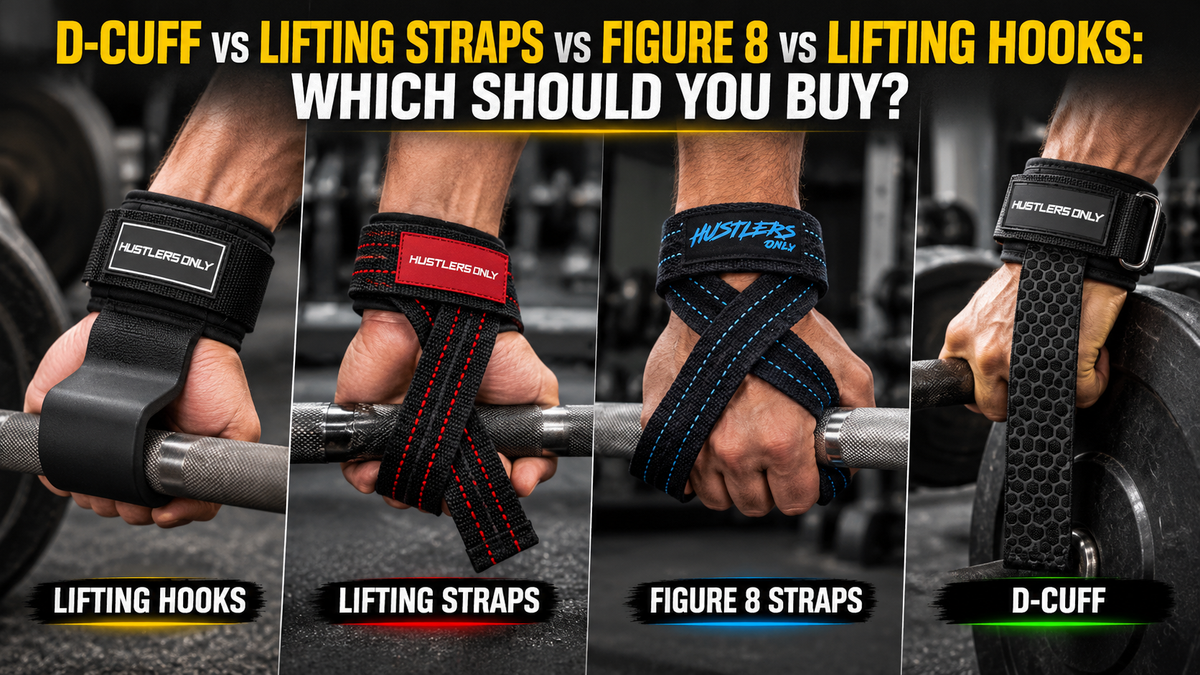
Normal straps can wrap around a cable handle, but they have no D-ring, so you'd still be holding the handle. To clip the cable directly to your wrist, you need a cuff with a D-ring. Our comparison of D-cuffs, straps, figure 8s and hooks explains the differences.
Are cuffed lateral raises better than dumbbell lateral raises?
They're a useful option rather than a replacement. Cables keep tension on the side delts through more of the movement, and cuffs take your grip out of it. You can use both in the same workout.
Will D-cuffs fit any cable machine?
Most cable machines use a clip (carabiner) that attaches to a D-ring. Check your gym's cable has a clip that opens and closes fully before you start.
Can I also use D-cuff straps for deadlifts and rows?
Yes. The strap section wraps around a bar like a normal lifting strap, so the same straps cover your heavy pulls too.
Can I pay cash on delivery?
Yes. Every order can be paid cash on delivery across Pakistan.
Final thoughts
D-cuff straps turn a cable machine into a tool for training your shoulders and back without your grip getting in the way. Start with lateral raises and straight-arm pulldowns, keep the weight light enough for clean reps, and build from there. Get your D-Cuff Lifting Straps from Hustlers Only, or browse our full lifting straps collection.
Share:
Are Lifting Straps Cheating? When to Use Straps (and When Not To)
D-Cuff Lifting Straps: What They Are and How to Use Them