

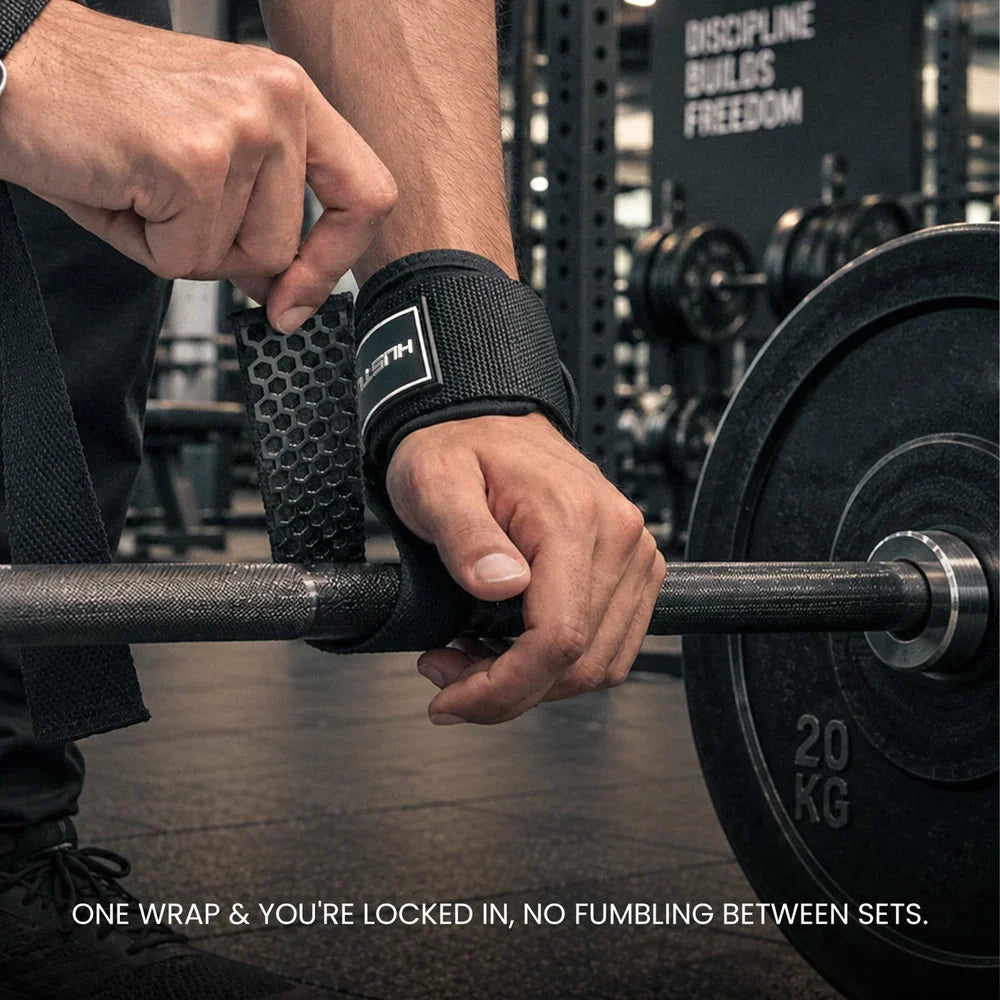
D-cuff lifting straps give you two tools in one: a lifting strap for heavy pulls and a cuff that clips onto a cable machine. This guide explains what they are, how to put them on, how to use them on a cable, and which exercises they're best for.
What are D-cuff lifting straps?
A D-cuff lifting strap combines three things:
- A wrist cuff that fastens around your wrist and gives it support.
- A lifting strap that wraps around a bar or handle, so the weight is held by the strap and your wrist rather than only your fingers.
- A D-shaped metal ring (the "D") that clips straight onto a cable machine, so you can pull from your wrist without a handle.
Regular lifting straps only do the second job. That makes D-cuffs handy if you train heavy barbell pulls and cable exercises in the same session.
Our D-cuff lifting straps
The Hustlers Only D-Cuff Lifting Straps are our best-selling lifting strap. In the 90 days to October 2026, they sold more units than any other strap or lifting hook in our store.
- Lifting strap, wrist support and D-cuff hook for cables in one
- Honeycomb-patterned strap grip
- 10-inch strap length
Regular price Rs. 3,200. At the time of writing (October 2026), they were on sale at 25% off; check the product page for the current price.
How to put on D-cuff lifting straps
- Slide your hand through the cuff and position it on your wrist, with the strap coming out on the palm side of your hand.
- Fasten the cuff so it's snug. It should stay in place without sliding towards your hand, but not be so tight that your fingers tingle.
- Take hold of the bar or handle, then wrap the strap around it.
- Close your hand over the strap and roll the bar slightly towards you to take up the slack. The strap should feel tight before you lift.
Practise the wrap with a light weight first, so it's quick and automatic when the weight gets heavy. At 10 inches, the strap is shorter than the 24-inch straps in our OG lifting strap range, so there's less to wrap.
How to use the D-ring on a cable machine
- Put the cuff on and fasten it snugly.
- Take the handle off the cable and clip the cable's carabiner directly onto the D-ring.
- Check the carabiner gate is fully closed before you start.
- Pull with your arm and keep your hand relaxed. Because the load is on your wrist, your grip won't end the set.
- Start lighter than you would with a handle until you're used to the feel.
Best exercises for D-cuff lifting straps
Using the strap (bars, dumbbells and handles)
- Deadlifts, Romanian deadlifts and rack pulls
- Barbell, dumbbell and seated cable rows
- Shrugs
- Lat pulldowns and pull-ups
Using the D-ring (cable machine)
- Cable lateral raises
- Cable rear delt flyes
- Straight-arm pulldowns
- Single-arm lat pulldowns and cable rows
Our guide to cable exercises with D-cuff straps walks through each cable movement step by step.
When to use them, and when not to
Use straps on sets where your grip would give out before the muscles you're training, usually your heaviest or highest-rep sets of pulling exercises. Research supports this: in a 2021 study on deadlifts, lifters had less grip fatigue and rated their sets as easier when they used straps.
- Skip them on warm-ups and lighter sets, so your grip still gets trained.
- Don't use them on lifts where you might need to let go of the bar quickly.
Worried straps are cheating or will weaken your grip? Read are lifting straps cheating?
D-cuff straps vs other lifting straps
Standard loop straps are simpler and cheaper, and figure 8 straps give the most secure hold on very heavy deadlifts and shrugs. Lifting hooks are the quickest to use, because there's nothing to wrap. D-cuffs are the only option of the four that also clips onto a cable machine. Our D-cuff vs lifting straps vs figure 8 vs hooks guide compares them in detail.
Frequently asked questions
What does the "D" in D-cuff mean?
It's the D-shaped metal ring on the cuff. You clip a cable machine's carabiner onto it, so the cable pulls from your wrist instead of a handle.
Can I use D-cuff straps for deadlifts?
Yes. The strap wraps around the bar like a regular lifting strap, so you can use it for deadlifts, rows, shrugs and pulldowns.
Are D-cuff straps good for lateral raises?
Yes. Clipping the cable to your wrist takes your grip out of the movement. Coach Jeff Nippard recommends cuffs over a handle for cable lateral raises; in his own test, he managed two extra reps with cuffs.
Are lifting straps allowed in powerlifting competitions?
Not in IPF powerlifting or Olympic weightlifting competitions, though they're common in training and allowed in strongman. If you compete, train some sets without straps.
What is the price of D-cuff lifting straps in Pakistan?
At Hustlers Only, the regular price is Rs. 3,200. Check the product page for the current price, as sales can bring this down.
Can I pay cash on delivery?
Yes. Every order can be paid cash on delivery across Pakistan.
Final thoughts
If you train heavy pulls and cable work, D-cuff lifting straps save you carrying two sets of kit. Use the strap when your grip is the weak link, use the D-ring for cable isolation work, and keep some sets strapless so your grip keeps up. Get yours from our D-cuff lifting straps page, or compare every style in our lifting straps collection.

Share:
Are Lifting Straps Cheating? When to Use Straps (and When Not To)
D-Cuff vs Lifting Straps vs Figure 8 vs Lifting Hooks: Which Should You Buy?