

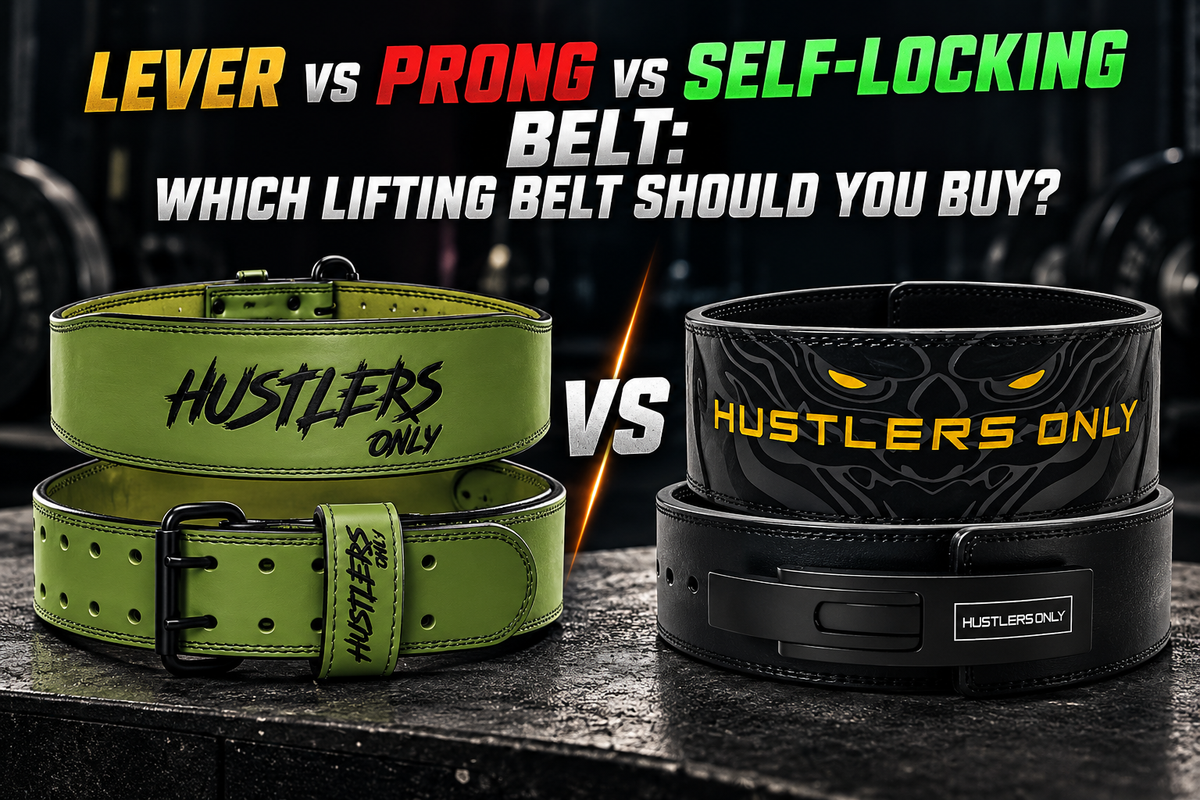
Lever, prong or self-locking? It's the first decision you'll make when buying a weightlifting belt, and each type suits a different kind of lifter. This guide explains how each one works, the pros and cons, and which one to choose for your training.
The three main types at a glance
| Lever belt | Prong belt | Self-locking (nylon) belt | |
|---|---|---|---|
| How it fastens | Metal lever clamps shut | Prong goes through a hole, like a trouser belt | Strap pulls through a roller buckle that locks |
| Usual material | Leather or suede | Leather or suede | Nylon |
| On and off | Fastest | Slower, especially when tight | Fast |
| Adjusting the fit | Usually needs a screwdriver | Any time, by changing holes | Any time, infinitely adjustable |
| Stiffness | Very stiff | Very stiff | More flexible |
| Best for | Heavy squats and deadlifts | Heavy lifting with flexible sizing | CrossFit, Olympic lifting, mixed training |
| Our regular price | From Rs. 8,000 | From Rs. 5,000 | Rs. 4,500 |
Lever belts
A lever belt closes with a metal lever. You set the buckle's position once, then flip the lever shut to lock the belt to exactly the same tightness every set. Flip it open and the belt comes off instantly.
Pros
- Same tightness every time, with no pulling or fiddling between sets
- Quickest to put on and take off, which helps between heavy sets
- Very tight closure for a hard brace
Cons
- Changing the fit usually means unscrewing and moving the buckle. On our suede lever belts, the buckle screws into 13 holes set one inch apart.
- Harder to share with a training partner of a different size
- Usually the most expensive option
Who should buy a lever belt?
Lifters who squat and deadlift heavy and want the same fit every session. If your waist size is fairly stable, a lever belt is the most convenient choice. Our 10mm Premium Weightlifting Lever Belt was our best-selling belt over the last 90 days.
Tip: want lever convenience with easier adjustment? The Anime Action Lever Belt has a buckle that adjusts every 0.5 inch without tools.
Prong belts
A prong belt fastens like a normal trouser belt: you pull it tight and push a metal prong through one of the holes. Single-prong belts have one prong; double-prong belts have two.
Pros
- Adjust the fit any time, which helps if your weight changes, you wear different layers, or you want it looser for deadlifts than squats
- Easy to share with a training partner
- Usually cheaper than a lever belt of similar quality
Cons
- Slower to put on and take off, especially when you want it very tight
- Tightness can vary slightly from set to set
- Double-prong belts can be fiddly to fasten
Who should buy a prong belt?
Lifters who want leather support on a smaller budget, people whose weight goes up and down, and anyone who likes different tightness for different lifts. The Weightlifting Prong Belt - Blackout is our most popular prong belt, and the Outlaw Single Prong Belt comes in suede leather.
Self-locking (nylon) belts
A self-locking belt is made from thick nylon webbing. You pull the strap through a roller buckle and it locks in place. To release it, you lift the buckle.
Pros
- Lighter and more flexible than leather, so it moves with you
- Infinitely adjustable, so you can get the exact tightness you want
- Quick on and off, useful in circuits and CrossFit-style workouts
- The most affordable option
Cons
- Less rigid than a thick leather belt, so it gives you less to brace against on maximum lifts
- Not allowed in IPF powerlifting competitions, which require leather or suede belts
Who should buy a self-locking belt?
CrossFit athletes, Olympic weightlifters, beginners who want to try a belt, and anyone who mixes lifting with running, jumping or other movement. Try the OG Self Locking Weightlifting Belt, 4 inches wide with a black titanium-coated roller buckle.
What about thickness: 10mm or 13mm?
Leather belts usually come in 10mm or 13mm thickness. A 13mm belt is stiffer but takes longer to break in and can dig in more, especially for shorter lifters. A 10mm belt gives solid support with more comfort, which is why it's the most common choice for everyday training. Our leather lever belts are 10mm thick and 4 inches wide.
Competition rules
If you plan to compete, check your federation's rules before you buy. The International Powerlifting Federation (IPF) allows belts up to 10cm wide and 13mm thick, made from leather or suede, with a lever, single-prong or double-prong buckle. The IPF also keeps a list of approved belt brands for its competitions. Olympic weightlifting allows belts up to 12cm wide.
Which belt should you choose?
| If you... | Choose |
|---|---|
| Squat and deadlift heavy and want the same fit every time | Lever belt |
| Want leather support on a smaller budget | Prong belt |
| Change weight often or share a belt | Prong belt |
| Do CrossFit, circuits or Olympic lifting | Self-locking nylon belt |
| Are buying your first belt and aren't sure | Self-locking belt to try, or a 10mm lever belt if you lift heavy |
| Want to add weight to dips and pull-ups | A dip belt, not a lifting belt |
Frequently asked questions
Is a lever belt better than a prong belt?
Neither is better for support; both are stiff leather belts. A lever belt is faster and more consistent, while a prong belt is easier to adjust and usually cheaper.
Are nylon lifting belts any good?
Yes, for the right training. They're lighter and more flexible, which suits CrossFit and Olympic lifting. For maximum squats and deadlifts, most lifters prefer a stiffer leather belt.
Can I adjust a lever belt if I lose or gain weight?
Yes. You move the buckle to a different set of holes with a screwdriver. If you'd rather adjust without tools, look at a prong belt or an action lever buckle.
Which belt is best for beginners?
If you mainly lift heavy, a 10mm lever belt is a solid first belt. If you want something cheaper and more flexible to start with, a self-locking nylon belt works well. Read our guide on how to wear a weightlifting belt before your first session.
Final thoughts
Lever belts win on speed and consistency, prong belts on flexibility and price, and self-locking belts on comfort and movement. Match the belt to how you train and you'll get years of use from it. Compare every style in our weightlifting belt collection, or see our picks for the best weightlifting belts in Pakistan.
Share:
Best Weightlifting Belts in Pakistan (2026): Our Top Picks
Best Weightlifting Belts in Pakistan (2026): Our Top Picks